Posts

Five Ways to Look More Impressive in a Video Call

Watch the gallery view in any video conference call or watch an inexperienced speaker trying to deliver a video workshop and you will notice that some people manage to look more impressive than others. How do they do it? And how can anyone do it without fancy equipment? There are five things that anyone can do right now: CAMERA AT EYE LEVEL . Place your camera so that the lens is at the same level as your eyes. Don’t lean over a laptop or phone. If you have a standing desk just raise it up to the right level. Otherwise place your laptop on a pile of boxes or books to bring it to the right height. If you are using your phone you can fix it to a tripod or place it on a shelf, but remember to always use it horizontally, like a TV. LIGHTING AND BACKGROUND . Before you start the call always check the lighting and background. Try to get as much light in front of you as you can – not behind or above – and keep the background uncluttered. Watch out for reflections on glasses and make s...

Don't Grab That Lectern!

Image
Most of the time the best policy for speakers is to stand out in the open. Don’t stand behind tables or lecterns if you can avoid it.  Standing in an open space is perhaps the most difficult for shy people, but is much more effective. Even standing beside the speaker’s table or lectern can be a good compromise, so you can peek at your notes but still be open to the audience. But there are some formal situations where you have to stand behind a lectern. Here you have no choice and you simply have to stand behind the lectern like everyone else. But you can still decide for yourself how to stand, and this can make a difference. Watching debates in the Swedish parliament I notice that there are some people who grab the lectern firmly with both hands, as if they are afraid it will try to run away, or if they are afraid of falling over. This projects insecurity and perhaps even a hint of aggression.  Other people rest their hands lightly on the top of the lect...

TED’s Magical Red Carpet

Image
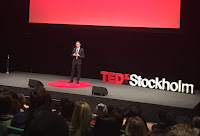
Watch any TED(x) video or, better still, attend a live event, and you will probably notice that speakers stand in the middle of a circular red carpet. This choice is not just a question of aesthetics. That red carpet actually plays a key role in the success of the TED format. Having the speaker stand in the middle of a red carpet has several important consequences, leading the speaker to follow best practices that they might not be aware of. No script or notes . Since there is no table, lectern or other furniture within reach, the speaker cannot easily read from a script. This forces them to deliver their talk from memory, which is much more compelling because few people can read from a script and make it sound natural. And no matter how good you are at reading, the audience can see that your eyes are scanning the text and this breaks the magical connection with their minds. Encouraging people to speak from memory pushes them to make a much better talk than they might ot...

Speaking: Why You Need to be Careful with "We"

Image
In his 1946 book “ How to be an Alien ”, the Hungarian-born British writer George Mikes tells a story about how newly naturalized citizens need to be careful about their use of we , us and ours . After hearing that 22 planes had been shot down, someone asked ‘What – ours?’, to which his English hostess answered icily ‘No – ours’. When I am coaching speakers or rewriting their speeches I am often reminded of this anecdote when I notice an ambiguous use of “we”. This is surprisingly common, but it can easily confuse or mislead an audience. At the very least it can be distracting because your brain is momentarily occupied trying to work out who “we” are exactly.  Imagine, for a moment, a product launch keynote by the CEO of the fictional Acme Computers. The CEO admits that “… we need to do more about privacy”. What precisely this means depends entirely on who “we” are. It could mean all of humanity, it could mean the people in the room, it could mean her company or it ...

Five Steps to Become an Awesome Speaker

Image
Every so often someone will ask me if it is possible for anyone to become a great speaker. Actually it is. Anyone can learn to become a compelling and memorable speaker, though it does require an investment in time and energy. But unlike many other skills, speaking is actually built on a surprisingly small number of key elements. There are just five of them. Master these five elements and literally anyone can become an effective speaker, even if they are starting from zero. 1 Speak as often as you can . If you speak once a year at a wedding, or once a quarter at a corporate meeting you will never become a really effective and confident speaker. You need to speak in front of a real audience at least once a month to become simply competent, but this is a minimum. Once a week would be better and if you can find periods where you speak every day or even several times a day it will be better. To make this happen you need to find some opportunity to speak regularly. You could voluntee...

Focus at Start is Key to Impactful Speaking

Image
Watching a speaker competition recently I noticed that even competent and confident presenters sometimes make a mistake that looks minor, but actually impacts negatively the first impression that they make on the audience. What they do is to mention something essentially irrelevant just before they start speaking, which is a both a distraction and can give people a negative feeling even before you start. This usually takes one of three forms, but the advice in every case is the same: don't do it. Dissing the equipment, venue or audience . One of my favorite TED talk videos begins with an irritating comment from the speaker that he dislikes head microphones. That may well be true but the audience is not interested, and focusing on that detail makes us think about other things and not the topic of his talk. Frankly we don't care if you don't like the equipment or any other practical detail of the event; that is between you and the organizers. In fact if you didn't ...

How to Build Support Quickly for Your Presentation

Image
Last year I wrote about what to do if you need to create an important presentation at the last minute in  The Dog Ate My Speech: Preparing an Important Presentation at the Last Minute . This focused on techniques for creating and learning effective content with very little time. But if you have time, another way to make last minute presentations more effective is to get the support of the audience before you start. Before most presentations there are breaks where people drink coffee and chat. You can use this time to mention your most important points to as many people as you can. Later when you are presenting you will probably notice these people nodding as you mention these points. Your ideas sound familiar so people show signs of recognizing them, and this gives encouraging body language feedback that will make you more confident. If you have a little more time, you could also try to organize a practice session with some of the people who will attend the real presentati...

Viking Age Tar Production and the Decoupling of Ideas

Image
Where do you get all your stories and examples from? This is a question that people often ask me after lectures and workshops. The short but unhelpful answer is that they come from my “ideas file”. This ideas file is not so much a file as a concept. At times it has been a box, a massive green folder, a notes file in my phone and all of the above. But how do the ideas get into the file? This is where the real secret lies. Searching for ideas and examples when you need them is extremely difficult and often frustrating. The solution is to decouple the search from the need. My method is to scan news and new research routinely and then to squirrel away all the things that could be useful one day. Some of these articles and research papers are useful almost immediately. Some wait in the conceptual ideas file for months or years before they suddenly become useful. Let’s take a concrete example. In October 2018 Andreas Hennius of the Department of Archaeology and Ancient Histo...

Getting People Used to New Ideas: The Nobel Center Case

Image
One odd little detail of the 2018 Swedish election campaign is how some parties chose to focus their social media message on attacking the proposed new  Nobel Center . Designed by David Chipperfield Architects, this new building is supposed to be built on Blasieholmen in central Stockholm, replacing an old customs house presently on the site. Some people love it; others clearly do not and there is an organised campaign to oppose the new building. What is interesting about this campaign is how commonplace it is. When the iconic Tower Bridge in London was first proposed it was widely ridiculed, so was the Tour Eiffel in Paris. Now nobody would ever consider removing either of them. Some buildings are, in fact, genuinely repellent. A glance at the winners of the Carbuncle Cup show clearly that some designs not only have no merit, they seem to suck the merit out of their surroundings, too. But many others are not precisely bad but unfamiliar. Why is it that a Tower Bridge or To...

Conference-proofing your presentation

Image
One of the frustrations of speaking at events is that your carefully crafted presentation will often appear different and sometimes unreadable on the big screen. You are much more likely to see the presentation the way you intended if you can use your own computer, but conference organisers prefer to have all the presentations loaded onto their own computer to speed the changeovers. Many presenters complain that the fonts appear differently, that the formatting is disrupted, that background images disappear and that the page is cropped, chopping away vital information. These problems are hard to avoid entirely but by taking a few simple precautions. Design for compatibility . Instead of designing your presentation for optimal appearance try to design it to maximise compatibility. Avoid using unusual fonts, special effects or embedded media content that might work on your own computer but not on others. Try also to keep slide construction clean, without cutting and pasting comple...

Going Beyond Google; How to Create Original Content

Image
Search engines like Google are immensely powerful tools for finding information, but they have one serious drawback: when everyone is using the same resource everyone ends up writing content that is depressingly repetitive. Google many topics and you will find that often all of the pages that you can find with a simple keyword search contain the same information. When all goes well that is the same content you find in the Wikipedia page, but more often you find the same misinformation simply repeated. At this point anyone else trying to write about the same topic usually ends up citing the same facts, anecdotes, evidence and stories that everyone else has cited, for the simple reason that everyone is Googling the same keywords and finding the same pages. By simply Googling a topic and then writing more content based on the same information you are unlikely to add anything new to human knowledge and understanding. So how do you create original content that doesn't simp...

The Dog Ate My Speech: Preparing an Important Presentation at the Last Minute

Image
You have an important speech or presentation coming up on Monday. It’s Sunday now and you have prepared nothing. Maybe it’s not your fault because the plan was changed at the last minute, or maybe you had allocated time to prepare but then there was an emergency to deal with. Or maybe it is your fault. But it doesn’t matter. Surprisingly, perhaps, the situation is not at all hopeless. You can always recover from a zero-preparation situation and sometimes it can even lead to a better outcome, provided that you know how to do it. Pretending to be ill or saying that the dog ate your speech might get you off the hook, but long term this will work against your credibility. Your best approach is to go ahead but to use a lean approach to crafting a brief but powerful speech. Here’s one way to solve the problem: First of all, throw away all of your old notes, slides and other materials. It’s tempting to try to recycle old stuff but you will find that trying to find and ad...

How Organic Networking Helps Introverts Grow Their Network

Image
Many people avoid networking because they are introverted or just shy, but a much better idea is to simply avoid the "artificial" networking opportunities like cocktail-hour mingles. You can get much better results anyway by networking organically through activities. When you are working with other people you naturally build strong connections as a side effect of the co-operation, simply by being a good team player, colleague, employee or manager. If you have any sort of job you are already building a network in your workplace and environment even though you are probably not aware of it. You can greatly increase the reach and effectiveness of this networking by adding other activities to your daily job. These activities could be other projects in your workplace or related to your work, like organizing a work event. They can also be activities outside of work. Probably the most effective of these outside activities is to volunteer for non profits that involve somethin...

Three Secrets of Calm Public Speaking

Image
After every talk that I do there are as many questions about speaking technique as there are about the actual content. One of the most interesting is "How do you stay so calm?" . Partly this is just a question of practice, but there are also some specific techniques that make this much easier. Here are three of them, techniques that anyone can master: Prepare a Backup "Unplugged" Version . Some stress is always caused by the fear that there will be technical problems with the presentation. No matter how many backup copies of the presentation you have and no matter how many tests that you have done before the show the projector can still fail or your laptop suddenly starts to misbehave. One way to avoid this stress altogether is to prepare a backup "unplugged" version that you can do using just a whiteboard, a flipchart or even nothing. You should create a minimal version with the essential content and make a list of the stories you will tell and t...

About that quote: "Ask What Needs to be Done"

Image
Every mentor at Startup Weekend Stockholm is invited to provide a quote for the Instagram event campaign. For the February 2018 Foodtech event I chose a thought that I had just tweeted when I was asked -- an idea that I have found very useful for solving difficult problems. Never ask if something can be done; ask instead what needs to be done to make it happen . This apparently simple change of perspective is surprisingly effective because it reframes the question from one about possibility to actually finding solutions. When you ask yourself or other people if something is possible you allow the possibility that it is not. By asking how it could be done you concentrate all your efforts on finding some sort of solution. Once you have taken away the option of simply walking away from the problem people tend to get much more creative in finding solutions. Perhaps you have to redefine the problem, or perhaps you need to adapt your expectations. But when there is no option to just...

How To Do Lists Give You Peaceful Nights and Weekends

Image
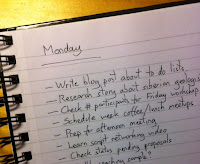
Every working week usually ends for me by writing a "to do" list for the work to be done the next week, or at least Monday. I do this partly so that I don't forget the work in progress, or the highest priorities, but it also has the useful side effect of making the weekend more relaxing. This offloading of the work still to be done onto paper or a file appears to lighten the load on your mind, since you know the list is safely written down and you don't need to keep thinking about it. How you do this mental offloading step doesn't seem to make any difference. At my own desk I tend to use a paper list and when I am travelling I often use an email to myself. Once the list is safely written you can mentally "close the office" for the weekend without being stressed by all the work still to be done. It has always worked for me, though I don't recall seeing any serious research to back it up. But now there is some experimental evidence that indirect...

Speaking: When it's Time to Lose the Slides

Image
In the business world most presentations are accompanied by Powerpoint or Keynote slides. This is so much taken for granted that the first instinct of many people when they are asked to speak is to put together a slide deck. Yet there are many cases where it can be more effective to present without slides. This approach has several advantages. First of all it reduces the amount of preparation overhead. Look around the offices of any large business and you will quite often see people spending way too much time on this activity. I have often wondered what would happen if presentation software could log and report hours of activity so that an organization could measure the overall cost of slide preparation. Better still, not only does it eliminate the time spent making slides, it also gives you more flexibility during the delivery, where you can pivot the presentation more easily in response to previous presentations or inputs from the audience. Perhaps a comment by someone else...

Pitching Innovations; When Spoilers Are a Good Thing

Image
Creators of fiction take great care to avoid leaks, from extra security guards hired to watch over the printing of a much anticipated new book to shooting multiple alternative endings for a TV series so that even the talent doesn't know what happens. But for entrepreneurs, developers and marketers who are trying to pitch an innovative new product, technology, idea or whatever, this is the worst way to approach a presentation. Perhaps in movies you can spring a complete surprise on someone in a literal elevator pitch, and they decide to greenlight it on the spot. Reality is different. People normally distrust new ideas the first time that they see them, but over time they come to accept and then like the new idea simply by being exposed to it. There is an important lesson in this idea. If people need time to get used to a new idea before they accept it then the effective influencer takes care to make sure that this happens. Long before you ask someone to decide about your g...

Use a Clicker to Improve Your Presentations

Image
There are many ways to make your everyday presentations more effective, though most of them involve some effort or at least practice. But there is one short cut that can make anyone a better presenter almost immediately: just buy a clicker and then use it. You might think that you only need one in big venues where you are too far away from the computer to use the keyboard, but this is not true. Even in your everyday office presentations you can boost your effectiveness by quietly using a clicker to change slides and to blank the screen. Why is using a clicker so important? First of all, by using a clicker you eliminate a major source of distraction both for you and the audience. If you are using the keys on your laptop then every time you want to change a slide you have to walk over to the laptop, find the key, press it and then go back to where you were. While you are doing this you have to pause momentarily what you are saying and you break eye contact with the audience. Ev...

The Favras Effect: Why you Should Always Ask Someone Else to Proofread for You

Image
No matter how carefully you proofread your own copy, some quite serious typos can slip through the net. But show the copy to someone else and they spot the errors immediately, even if they merely glance at the text. Usually this person who spots the obvious error with a mere glance is your boss, doubling the embarrassment. In workshops I often call this the Favras Effect after the French aristocrat Thomas de Mahy, marquis de Favras, who was hanged on 19 February 1790 for being on the wrong side in the French Revolution. Just before he was hanged he was shown his death sentence, glanced at it and observed "Je vois que vous avez fait trois fautes d'ortographe". -- "I see that you have made three spelling mistakes".  Because of this comment Mahy has since had a reputation for his coolness in difficult circumstances, though it is quite likely that other people in similar situations might also have seen obvious errors that everyone else missed, but eithe...