Posts

Three Non-Obvious Issues in Multicultural Meetings

Image
When you are planning a meeting with people from different cultures maybe you have already prepared by learning about the way people greet each other and other surface cultural differences. But chances are that your meeting might be derailed by some non-obvious cultural misunderstandings. Here are the top three problems I have seen in workshops and coaching people about intercultural business. 1. MEETINGS DON'T ALWAYS HAVE THE SAME SCOPE. This is probably the hardest intercultural issue for most people because they rarely if ever ask themselves what a meeting is for, yet this basic concept is the root of many conflicts. In the USA and some western European countries meetings are usually open forums where new ideas can be discussed -- even ones that have never been raised before -- and decisions are taken that will automatically be implemented later. There are significant variations to this approach in many other countries. In Japan, for example, decision making is by consensu...

Three Timesaving Tips for Email -- Five Minutes to Boost Your Productivity

Image
By following just three simple tips any email user can save time for themselves and everyone else, cutting the time you need to spend on mails and reducing stress. Anyone can learn this in five minutes. 1. PUT SOME MEANINGFUL CONTENT INTO SUBJECT.  By far the easiest way to make your emails easier to find, understand and act on is to put the heart of the message into the message subject. This means that people will see it even when they are only looking at a list of pending messages. Let's suppose that a webinar has been scheduled, the subject "Webinar" would be almost useless. Much better to write "Networking webinar scheduled for 11 January". This simple trick means that people are much more likely to open your message and read it. In some cases they may not even need to open it. For example, if I send someone a link and they answer with a short mail with the subject "Thanks for the link" I don't need to open it. Months later if you need to...

Choosing Pronounceable Brand Names: Learning from the Cuil Story

Image
Recently I wrote a detailed note about the process of discovering and selecting brand names that are search engine friendly -- Branding in the Age of Search Engines .  What this note did not cover was the issue of pronounceability  which is a problem so complex it would not fit into a single bullet point but is critically important for businesses. When the Internet search site Cuil closed last month I was not surprised. I believe a number of factors contributed to this closure, but one of them is certainly the fact that they had to teach people how to pronounce their name. The founders explained that it should be pronounced like "kool", which they said was an Irish word meaning knowledge, though language experts disputed this. You might think that making a pronounceable name is a no brainer, but there are actually several separate issues you need to think about, and Cuil got all three wrong. 1. CAN NATIVE SPEAKERS MISPRONOUNCE IT?   Unless you ar...

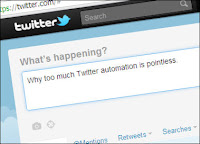
When Bot Talks to Bot: Why Too Much Twitter Automation is Pointless

Image
Every day I get followed by Twitter accounts that are obviously using some sort of autofollow tool triggered by a keyword in one of my tweets. I know that they are autofollows because it is clear that the account has no interest in my content and it is unlikely I would be interested in theirs. Most use a crude keyword trigger so that if I were to tweet that I hate carrots I would be followed by carrot vendors, which is clearly pointless. Mostly these accounts are also just broadcasting a sequence of prefabricated tweets, something I can verify just by sending an @reply to see if there is a human who can respond. Usually there isn't. At this point I am not going to follow back this kind of account and most other thinking humans would do the same, but out of curiosity sometimes I look to see who *is* following them. Very often the accounts that follow autofollow bots are other autofollow bots.  So what is happening is that one bot is tweeting to another bot and there a...

One Tool to Rule Them All: The Magic of If This Then That

Image
Most social media and social networking sites allow some limited interaction between different channels. So, for example, you could link your Twitter and LinkedIn accounts so that all your tweets go into your LI status updates. Using tools like Hootsuite and Tweetdeck you can also schedule actions across several platforms at certain times. And there are many tools that allow you to setup automated responses, like the annoying direct messages some autofollow robots send when you follow their account. If This Then That goes much further and has created what is effectively a new One Tool To Rule Them All , a deceptively simple utility that allows you to setup "tasks" so that actions in one channel -- twitter, a blog, weather, stock prices, emails, your mobile phone and so on -- can trigger an action in another. You can, for example, setup an automatic email whenever it rains in a certain location. You can auto-archive a photo on dropbox when you have been tagged in it and ...

How to Detect Facebook Scams & Hoaxes Using A Simple Google Search

Image
Every week there is a new wave of Facebook scams and hoaxes. Sometimes it is a warning that you will have to pay for Facebook if you don't click on a link. Other times it is the promise of seeing who viewed your profile, if you click on some link. There are others promising the Secrets of Farmville -- if you click on a link.  This week one of the most popular Facebook scams is the one announcing that Apple is giving away free iPads in memory of Steve Jobs, you just have to click on that link. But click on any of these links and bad things happen. So how do you recognize which Facebook messages are genuine and which are tricks? Since I have worked in PR most of them are obvious to me. A company like Apple wanting to get news to customers never sends it by a chain letter or a Facebook wall post you have to share with friends; they are more likely to post it on their website, send out a release to the media.  But for everyone else, is there a simple way to detect them? ...

Selling Your Ideas: Influencing Your Way to Success

Image
When someone has a great idea -- a new product, a reorganization, a cost saving move or whatever -- what often happens is that they make a presentation to the decision maker in a meeting. This is actually one of the worst ways and makes rejection much more likely because it doesn't take into account human nature. Rarely do decision makers decide in isolation; usually they are influenced by the opinions of others. If everyone else in the room is shaking their heads as you speak this is going to have an impact on the final decision. For this reason in workshops and one-to-one coaching I always combine practical speaking and presenting techniques with the essentials of influencing strategies and tactics, based on research in applied psychology and some tested methods that have proven very effective in the past. But suppose you don't have time for a workshop right now. What can you learn in just five minutes reading that will help you become an effective influencer?  Here a...